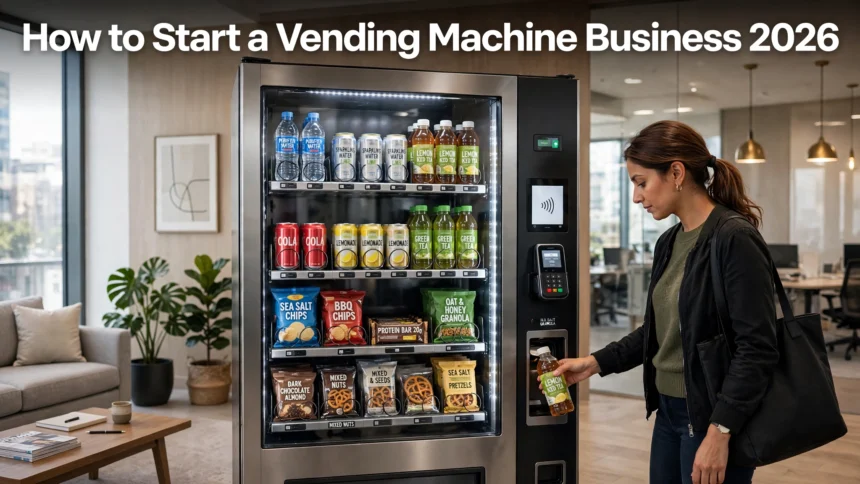
Starting a vending machine business in 2026 remains one of the most approachable ways to build a side income or a full-time operation. Machines work around the clock, require no employees at each location, and let you grow at your own pace from a single unit to a full route.
- Why Start a Vending Machine Business in 2026
- Understanding the True Startup Costs
- Choosing the Right Machines for Your Business
- Finding and Securing Profitable Locations
- Licenses, Permits, and Legal Setup
- Selecting Products That Actually Sell
- Cashless Payments and Smart Technology
- Running Day-to-Day Operations
- Scaling Your Route for Growth
- Conclusion
That said, it is not the effortless passive income that some social media videos suggest. Success depends on choosing good locations, managing costs carefully, and doing the weekly work of restocking and maintenance. This guide walks through the full process, from startup costs and machine types to licenses, locations, products, and profit strategies, using typical 2026 United States pricing from current industry guides.
Why Start a Vending Machine Business in 2026
The vending industry still offers a genuine opportunity for new entrepreneurs. Offices, gyms, hospitals, and schools need convenient food and drink options, and rising comfort with cashless payments has made transactions smoother than ever. A well-placed machine in a busy workplace can generate steady weekly sales with relatively little day-to-day effort from the owner.
The low barrier to entry is another major draw. You do not need a storefront, employees, or a huge investment to begin. A single used machine, properly stocked and placed in the right spot, can be launched for a few thousand dollars, and many operators run their routes around full-time jobs, reinvesting profits into additional machines over time.
Understanding the True Startup Costs
The machine is the biggest expense, but it is far from the only one. Industry guides for 2026 put used machines at one thousand to three thousand dollars, new traditional machines at three thousand to six thousand dollars, and smart machines at six thousand to fifteen thousand dollars or more. Used machines need careful inspection, since breakdown risk is higher without a warranty.
The other costs add up quickly. Initial inventory runs two hundred to five hundred dollars per machine, delivery and installation another one hundred fifty to five hundred, and a card reader two hundred to five hundred dollars if the machine lacks one. Business licenses and permits cost roughly fifty to three hundred dollars depending on your state and city, with possible health department permits for food machines. Add general liability insurance at around three hundred to six hundred dollars per year, storage setup, and a contingency reserve of at least five hundred dollars, and a realistic all-in budget for a first machine lands between three thousand and six thousand dollars.
Choosing the Right Machines for Your Business
The machine you buy should match your target locations and products. Traditional snack and drink machines are the most common starting point: affordable, widely available used, and easy to service. Combination units that sell both snacks and beverages save space and suit offices with room for only one machine. For beginners, starting with one or two proven formats keeps things simple while you learn the business.
Smart vending machines represent the higher end, with touchscreens, cashless payments, and remote monitoring that reports inventory and sales to your phone.
Finding and Securing Profitable Locations
Location is the single most important factor in vending, and experienced operators agree that a mediocre machine in a great spot beats a fancy machine in a dead one. The best locations have a captive audience with limited alternatives: offices, manufacturing plants, gyms, hospitals, colleges, apartment complexes, and repair shops.
Winning a placement means convincing a property owner or manager to host your machine. Many operators offer a commission, either a percentage of sales or a flat monthly fee, in exchange for the space and electricity. A written location agreement protects both sides by covering the commission, electricity costs, maintenance duties, and notice terms. Expect plenty of rejections before your first yes, and treat every pitch as practice. Once one machine performs well, convincing the next business owner becomes much easier.
Licenses, Permits, and Legal Setup
Vending is a real business and needs proper legal foundations. While you are not strictly required to form a limited liability company, most guides strongly recommend it, since an LLC separates business debts and legal risks from your personal assets. Formation costs range from one hundred to five hundred dollars depending on the state, with annual renewals of fifty to eight hundred dollars.
Permit requirements vary by state and city but typically include a general business license, a seller’s permit for collecting sales tax, and an Employer Identification Number from the IRS. Food and beverage machines may need a health department permit and possibly an inspection of your storage setup. Vending sales are subject to sales tax in most states, so track revenue carefully from day one with simple accounting software or a well-kept spreadsheet.
Selecting Products That Actually Sell
Your product mix should match the tastes of the specific audience at each location. An office of young professionals might favor healthier snacks, energy drinks, and premium coffee, while a manufacturing plant might prefer hearty snacks and sodas. There is no universal best lineup, which is why testing and adjusting based on real sales is so important.
Pricing means balancing profit margins against what customers will actually pay. Industry benchmarks suggest net margins of twenty-five to thirty-five percent after product costs, commissions, and operating expenses, with realistic take-home profit of forty to one hundred twenty dollars per machine per month early on. Sourcing cheaply is a skill that develops with experience: wholesale clubs, restaurant supply distributors, and dedicated vending suppliers all offer competitive prices, and bulk buying across multiple machines improves margins.
Cashless Payments and Smart Technology
In 2026, cashless payment is no longer optional for most locations. Customers expect to pay with a card, phone, or smartwatch, and machines that only accept coins and bills lose sales every day. Adding a modern card reader costs two hundred to five hundred dollars, and the investment typically pays for itself through higher transaction volume and larger average purchases.
Smart technology goes further. Connected machines can report sales, inventory levels, and error codes directly to your phone, so you can see which machines actually need restocking and which can wait. There are costs in monthly connectivity fees and per-transaction processing charges, so price your products to absorb payment fees rather than surprising customers with extra charges at the reader.
Running Day-to-Day Operations
The daily reality of vending is a routine of restocking, cleaning, and maintenance. A busy machine might need servicing twice a week, while a slow one can go two weeks between visits. Each visit means refilling sold products, removing expired items, wiping down surfaces, emptying coin mechanisms, and confirming every selection vends correctly.
Maintenance catches many beginners off guard. Refrigeration units fail, bill acceptors jam, and card readers lose connectivity, so learning basic troubleshooting saves you from paying a technician for every small issue. Keep a small stock of spare parts for your most common machine model. Customer service matters too: post a visible contact number or QR code on each machine, and respond fast when a machine eats someone’s dollar. Happy hosts renew location agreements; unhappy ones replace you with a competitor.
Scaling Your Route for Growth
Once your first machines run profitably, the path to growth is straightforward: reinvest profits into more machines and better locations. Many operators add a new machine whenever the existing route generates enough surplus cash to fund one, a disciplined approach that avoids debt while building a fleet with compounding earning power.
As you scale, efficiency becomes the key challenge. Group machines geographically to cut driving time and fuel costs, and consider a dedicated van with inventory shelving once you pass ten machines. The most successful operators also learn to prune: if a spot underperforms after you have tried different products and pricing, move the machine somewhere with better potential. Ruthless focus on your best locations is what separates a profitable route from a collection of mediocre machines.
Building wealth looks different for everyone. For a celebrity perspective, read our profile of Sofia Vergara’s net worth in 2026, which traces how she built a reported $180 million fortune through television, endorsements, and business ventures.
If vending has you thinking about other business ideas, take a look at our roundup of the most profitable small businesses in 2026 for more low-cost opportunities to explore.
Conclusion
Starting a vending machine business in 2026 is a realistic path to building income, but it rewards those who treat it as a genuine business rather than a passive investment. The formula is straightforward: budget honestly for the full startup costs, choose reliable machines, secure locations with real demand, handle the legal paperwork, stock products people want, and embrace cashless technology. Each step is manageable on its own, and together they form a solid foundation.
The numbers tell an encouraging story for patient operators. With startup costs of a few thousand dollars per machine, monthly gross revenue of one hundred fifty to four hundred dollars per well-placed unit, and net margins of twenty-five to thirty-five percent, a small route can grow into meaningful income within a couple of years. For entrepreneurs willing to build steadily, vending remains one of the most accessible businesses you can start in 2026.